Tag Archives: Mark Davis

Invitation to book launch January 29th 11 am CET “Crisis, Inequity and Legacy: Narrative analyses of the COVID-19 pandemic” (Oxford University Press)

You are warmly invited to the online launch of Oxford University Press edited book ‘Crisis, Inequity and Legacy: Narrative analyses of the COVID-19 pandemic”, on January 29th 2026 at 11 am CET.

The online launch will be chaired by the editors of the book, Prof. Mark Davis, myself, and Dr. Sanny Mulubale, and include contributions from authors as well as from our panelist Dr. Felicitas Sofia Holzer, Senior Researcher, Institute of Biomedical Ethics and History of Medicine, University of Zurich.
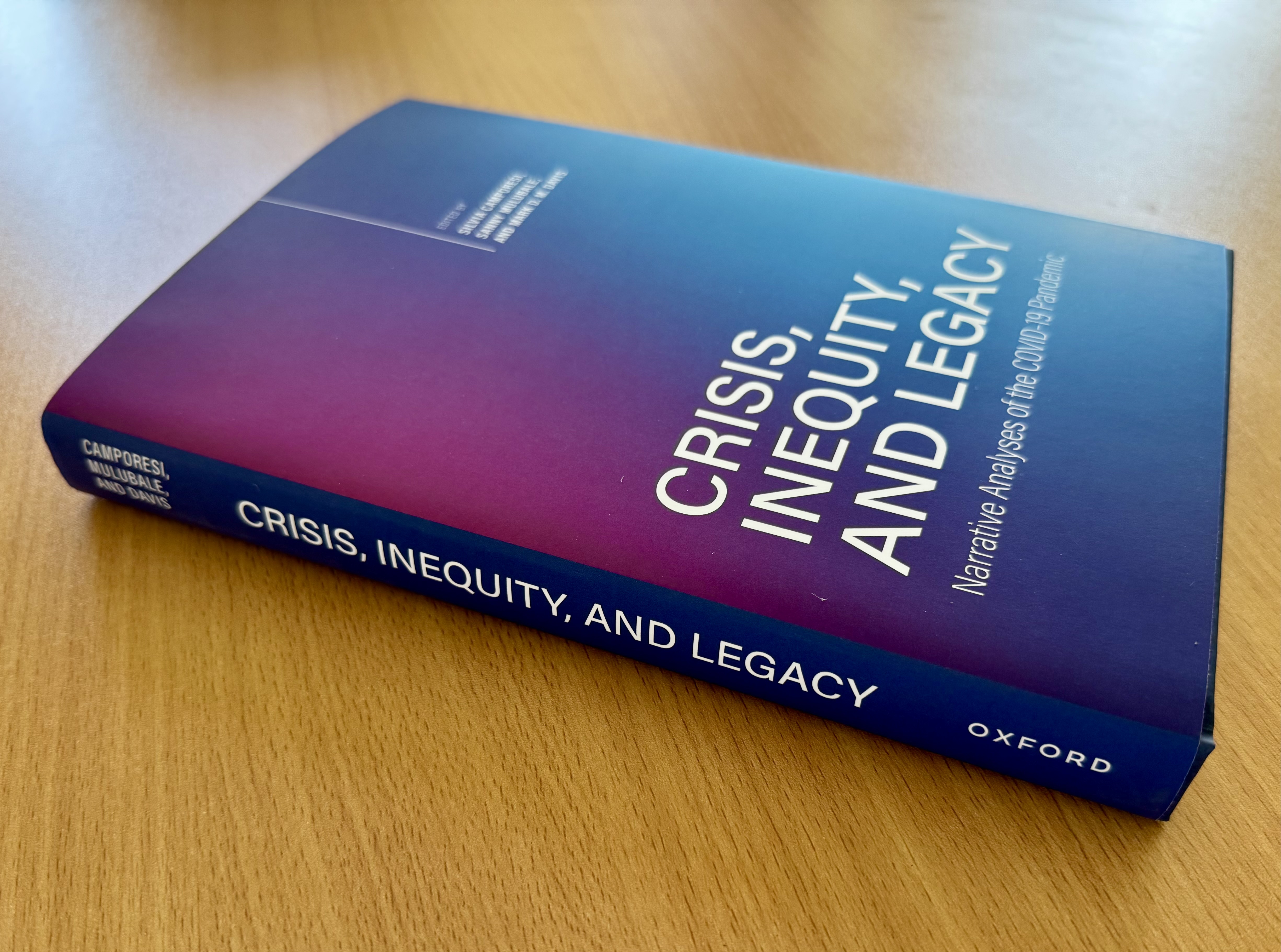
The book examines how COVID-19 narratives function as models of sense-making, how they connect public and private life, and what they make possible in social worlds. It emphasizes the little heard stories of those struggling with the pandemic’s effects, featuring stories from across the world found in literature, social research, media, public health, and science. In doing so, it provides insight into the inequitable social burdens associated with the COVID-19 crisis.

Further information about the book can be found here:
https://lnkd.in/dHC_u8sw

Link to register here:
https://shorturl.at/YX50c

All are welcome. Join us to celebrate the book and reflect on research and engagement, post-COVID19.

Upcoming seminar October 19th, 2022 “COVID-19 narrative research seminar”

Dear colleagues

You are invited to our COVID-19 narratives research seminar on 19 October 2022.

Timezones

  • 8pm to 9:30pm, Melbourne Australia AEST
  • 11am to 12:30pm, London
  • 12pm to 1:30pm, Johannesburg

All welcome!

Please register here.

The zoomlink will be sent prior to the event.

For more info contact mark.davis@monash.edu

Abstracts and Bios

Proportionality in public health ethics, fear and state of exception: a narrative ethics approach to lockdown in Italy in 2020

Dr Silvia Camporesi, King’s College London

This article focuses on lockdown in Italy in 2020 and proceeds as follows. I first provide a background on lockdown measures in Italy in 2020 and on the institutional framework for crisis management in Italy. I then outline the public health principles of proportionality and least infringement, before moving on to present the public perception and lived experiences of the ban on outdoor exercise in Italy in 2020. I then present a critical narrative ethics analysis of the Emilia-Romagna Governor Stefano Bonaccini’s decision to introduce the restriction on outdoor exercise. I conclude discussing the implications of specific narratives employed to frame the emergency for the mobilisation of types of expert knowledge to manage the crisis, for construction of cultural memory of the pandemic, and for its biopolitical legacy.

Covid Autofictions

Dr Maria Vaccarella, University of Bristol

This presentation will explore creative writing responses to Covid19, more specifically fake Covid narratives on social media and established writers’ literary responses to Covid. I am interested in investigating to what extent these narratives contribute to and interrogate the presence of a globalized medical, as well as literary, community, while relying on an intricate web of transhistorical intertextual references.

Preview! Online first – selected articles from the Journal of Bioethical Inquiry Public Trust in Expert Knowledge Symposium

Guest Editors: Dr Silvia Camporesi, Bioethics & Society, King’s College London, London UK; Dr Maria Vaccarella, Medical Humanities, University of Bristol, UK; Dr Mark Davis, Sociology, Monash University, Melbourne, Australia.

Trust_FreeImages.com_Berkeley-Robinson-470x260Timeline for publication

The special issue is expected to appear online in late January 2017 and in print in June 2017

Five articles are already available online ahead of print publication!

TABLE OF CONTENTS

  1. Silvia Camporesi, Mark Davis and Maria Vaccarella, “Investigating Public Trust in Expert Knowledge:  Ethics, Narrative and Engagement”
  2. Katie Attwell, Julie Leask, Samantha Meyer, Philippa Rokkas, and Paul Ward, Murdoch University, Australia, Vaccine rejecting parents’ engagement with expert systems that inform vaccination Programs”
  3. Daniel Z. Buchman, Anita Ho, and Daniel S. Goldberg, University of Toronto, “Investigating Trust, Expertise, and Epistemic Injustice in Chronic Pain”
  4. Deborah Bowman, St George’s Medical School, University of London, “The Moral of the Tale: Stories, Trust and Public Engagement with Clinical Ethics via Radio and Theatre”
  5. Jennifer Edwell, and Jordynn Jack, University of North Carolina at Chapel Hill “Gestational Diabetes Testing, Narrative, and Medical Distrust”
  6. Karen Anne-Wong, University of Sydney, Australia Donor Conception and ‘Passing’: Why Australian Parents of Donor-Conceived Children Want Donors Who Look Like Them

About the special issue:

Trust pervades personal, social and political life. Basic trust is seen as the foundation of self, trust figures in the everyday reciprocity of social relations, and governmentality is imbued with questions of trust and distrust. Trust in expert knowledge (i.e. willingness to believe, endorse and enact expert advice) has emerged as a problem for governments seeking to engage and influence publics on matters as wide-ranging as public policy on the environment and economic development, biopolitics, and wellbeing over the life course. The knowledge systems which support climate change policy have been criticized and even refuted, leading to public policy challenges for action on climate. The uptake of vaccines in populations appears to be eroding and scientific/ethical controversies have marked the field. The emerging ‘superbugs’ crisis requires that publics engage with the idea that antimicrobials are no longer available to the extent they once were. Biotechnological interventions in reproductive life and health are subject to changed expectations for expert and consumer rights and responsibilities. Against this backdrop of troubled trust, expert knowledge and changing bio/ thanopolitics, how can governments engage publics? How do public communications take effect? How do experts and publics narrate trust? What are the ethical ramifications of efforts to garner, sustain or regain public trust? As some have argued, are we already post-trust and therefore in alternative modes of public engagement with the idea of collective life?

This special issue is the first of its kind to examine the ethics of public trust in expert knowledge systems in emergent and complex global societies. Through an interdisciplinary approach, it draws from contributions in bioethics, the social sciences and the medical humanities.