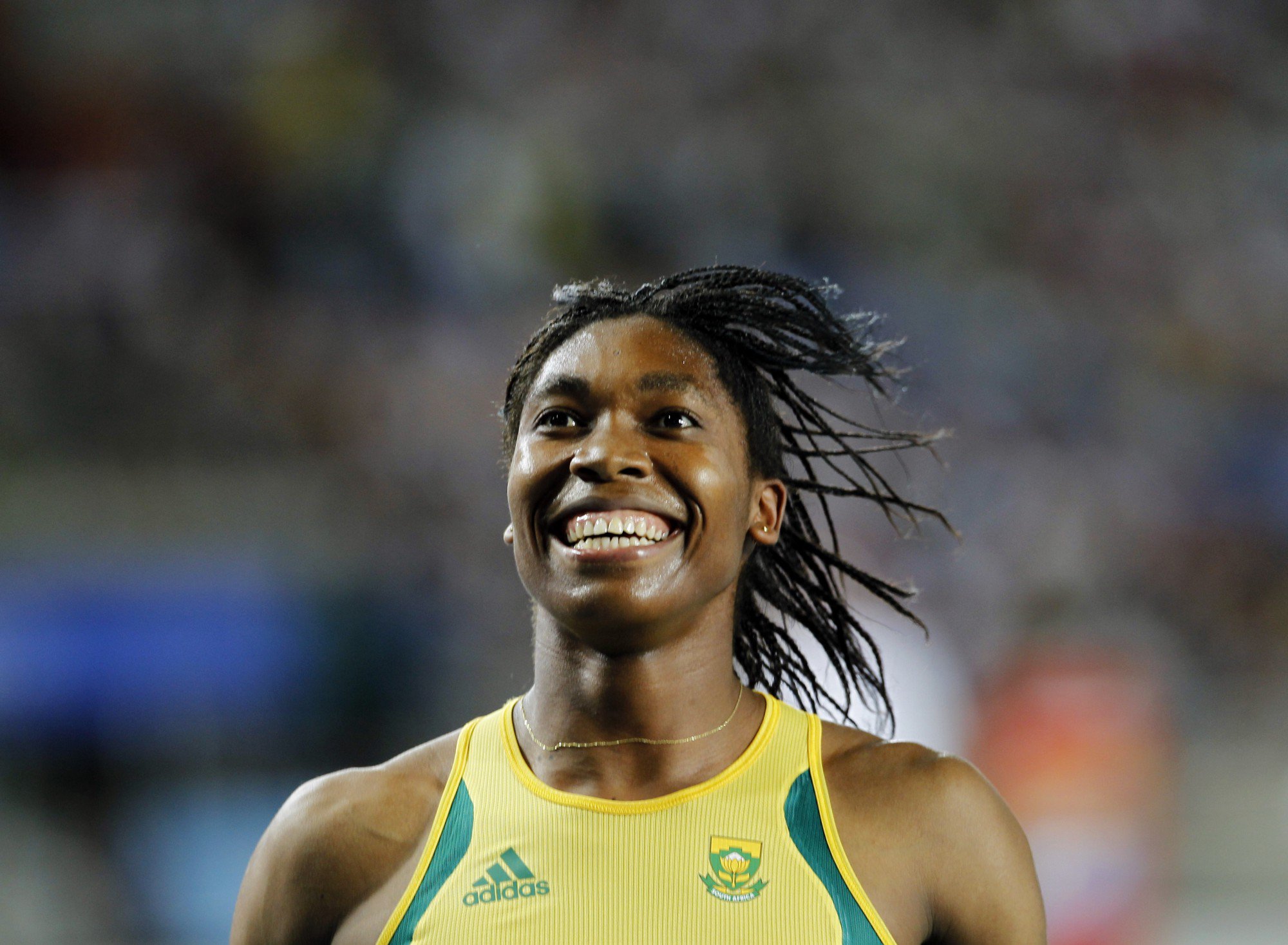
 An almost complete (I hope!) list of my academic works on the topic of hyperandrogenism, and eligibility criteria for participation in the female category from 2009 up to now can be found here (email me to request PDFs of articles if you don’t have access):
- Williams, AG, Heffernan, SM, Herbert, AJ, Hamilton, BR, Sánchez, FJ, Gollish, S, Rutherford, A, Montgomery, HE, McNamee, M, Camporesi, S, Ospina-Betancurt, J, Fife, N, Cox, L, Holt, RIG, Pitsiladis, YP, Malinsky, FR, Guppy, F, Pape, M, Vilain, E, Pielke, R, Cable, NT, Chantler, S, Phillips, SM & Stebbings, GK 2024, ‘Fair and Safe Eligibility Criteria for Women’s Sport: The Proposed Testing Regime Is Not Justified, Ethical, or Viable’, Scandinavian Journal of Medicine & Science in Sports, vol. 34, no. 11, e14753. https://doi.org/10.1111/sms.14753
- Camporesi, S., Teetzel, S. (2024) In praise of logical inconsistency: World Athletics and the evidence bar of the “reasonable person in good faith”. American Journal of Bioethics doi:10.1080/15265161.2024.2399860
- Camporesi, S., S. Teetzel, J. Ospina-Betancurt (2024) Eligibility Criteria to Compete in the Women’s Category for Athletes with Differences of Sex Differentiation: A review of Values, Norms and Evidence, International Journal of Sports Law, https://doi.org/10.1007/s40318-024-00280-x
- Camporesi, S. (2024). Cultural constructs of the body. Science, 385(6707), 374-374.
- Camporesi, S. & Hämäläinen (2021) The construction of categories in sport: Unfair Advantages, Equality of Opportunity and Strict Attainability. European Journal of Sports Sciences 1-13
- Camporesi, S. & Hämäläinen (2020) A local criterion of fairness in sport – comparing the property advantages of Caster Semenya and Eero Mäntyranta with implications for the construction of categories in sport. Bioethics, 35(3), 262-269
- Camporesi, S. (2020) The legacy of Caster Semenya: Examining the normative basis for the construction of categories in sport. Journal of Medical Ethics, 46(9), 597-598
- Camporesi S (2019) When does an advantage become unfair? Empirical and normative concerns in Semenya’s case. Journal of Medical Ethics;45:700-704.
- Camporesi, S. (2018) A question of ‘fairness’: Why ethics should factor in the Court of Arbitration for Sport’s decision on the IAAF Hyperandrogenism Regulations British Journal of Sports Medicine, 53:797-798.
- Camporesi S (2017) “Who is a sportswoman?” AEON essay https://aeon.co/essays/sports-culture-binds-us-to-gender-binaries-this-is-unfair [open access]
- Camporesi S, Maugeri P (2016), “Unfair Advantages and the Myth of the Level Playing Field in IAAF and IOC Policies on Hyper-Androgenism: When is it fair to be a woman?” in Olivesi A & Montanola S (editors) Gender Testing in Sport: Ethics, Cases and Controversies Routledge [email me for chapter and postface to volume]
- Camporesi S (2015), Ethics of Regulating Competition for Women with Hyperandrogenism. Clinics in Sports Medicine 35(2): 293-301 http://europepmc.org/abstract/med/26832978 [email me for pdf article]
- Karkazis, K., Jordan-Young, R., Davis, G., & Camporesi, S. (2012). Out of bounds? A critique of the new policies on hyperandrogenism in elite female athletes. The American Journal of Bioethics, 12(7), 3-16. http://www.bioethics.net/articles/out-of-bounds-a-critique-of-the-new-policies-on-hyperandrogenism-in-elite-female-athletes/ [open access]
Op-eds can be found here:
And you can find some of my early academic work on Caster Semenya here:
IMPORTANT!
Here you can download the original IAAF documents on Hyperandrogenism Regulations (they have been taken off website since suspension of regulation in July 2015 following CAS ruling)
IAAF guidelines Eligibility Hyperandrogenism May 2011
IAAF Hyperandrogenism Regulations – Appendices
MEDIA AND OUTREACH
Radio and Television Commentary and Expert Opinion
Al Jazeera Inside Story (May 2019, Television)
Commentary on CAS ruling against Caster Semenya:
https://www.aljazeera.com/programmes/insidestory/2019/05/athletics-rules-unfairly-target-caster-semenya-190502192112795.html
BBC Radio 5 (May 2019, Radio)
Commentary on CAS ruling against Caster Semenya:
https://www.bbc.co.uk/sounds/play/p0769g7f
BBC Radio London (May 2019)
Commentary on CAS ruling against Caster Semenya:
https://www.bbc.co.uk/sounds/play/p0769g7f?fbclid=IwAR1BVHBoJc9R5TxHMJAZHkXNjLx5caiZYOw3StVnNhck81XJ6tqMuIQ2ajg
BBC Inside Science (April 2019, Radio)
Commentary on experiments carried out at Yale University to reanimate pig heads:
https://www.bbc.co.uk/programmes/m00046sj
BBC Big Questions (June 2017, Television)
Panelist for episode “Is it ethical to interfere with the genome?”:
http://www.bbc.co.uk/iplayer/episode/b08vg018/the-big-questions-series-10-episode-20
BBC News Hour Extra (July 2016, Radio)
Commentary for: “A flickering flame: Is the Olympic ideal dead?”:
http://www.bbc.co.uk/programmes/p04263n3
BBC World Service (March 2015, Radio)
Commentary on Dutee Chand’s case:
https://soundcloud.com/bbc-world-service/what-makes-a-woman
BBC Have Your Say (March 2015, Radio)
Commentary on Dutee Chand’s case:
http://www.bbc.co.uk/programmes/p02m31rq
BBC Radio 4 News (March 2015, Radio)
Commentary on Dutee Chand’s case:
http://www.bbc.co.uk/programmes/b05mrc53
BBC World News (February 2015, Television)
Commentary on the case of eugenics victims receiving compensation for sterilization in Virginia:
https://www.youtube.com/watch?v=-kDev7pyloM
My work on Caster Semenya has been quoted in mainstream media and other professional outlets:
IMPORTANT!
Here you can download the original IAAF documents on Hyperandrogenism Regulations (they have been taken off website since suspension of regulation in July 2015 following CAS ruling)
IAAF guidelines Eligibility Hyperandrogenism May 2011
IAAF Hyperandrogenism Regulations – Appendices

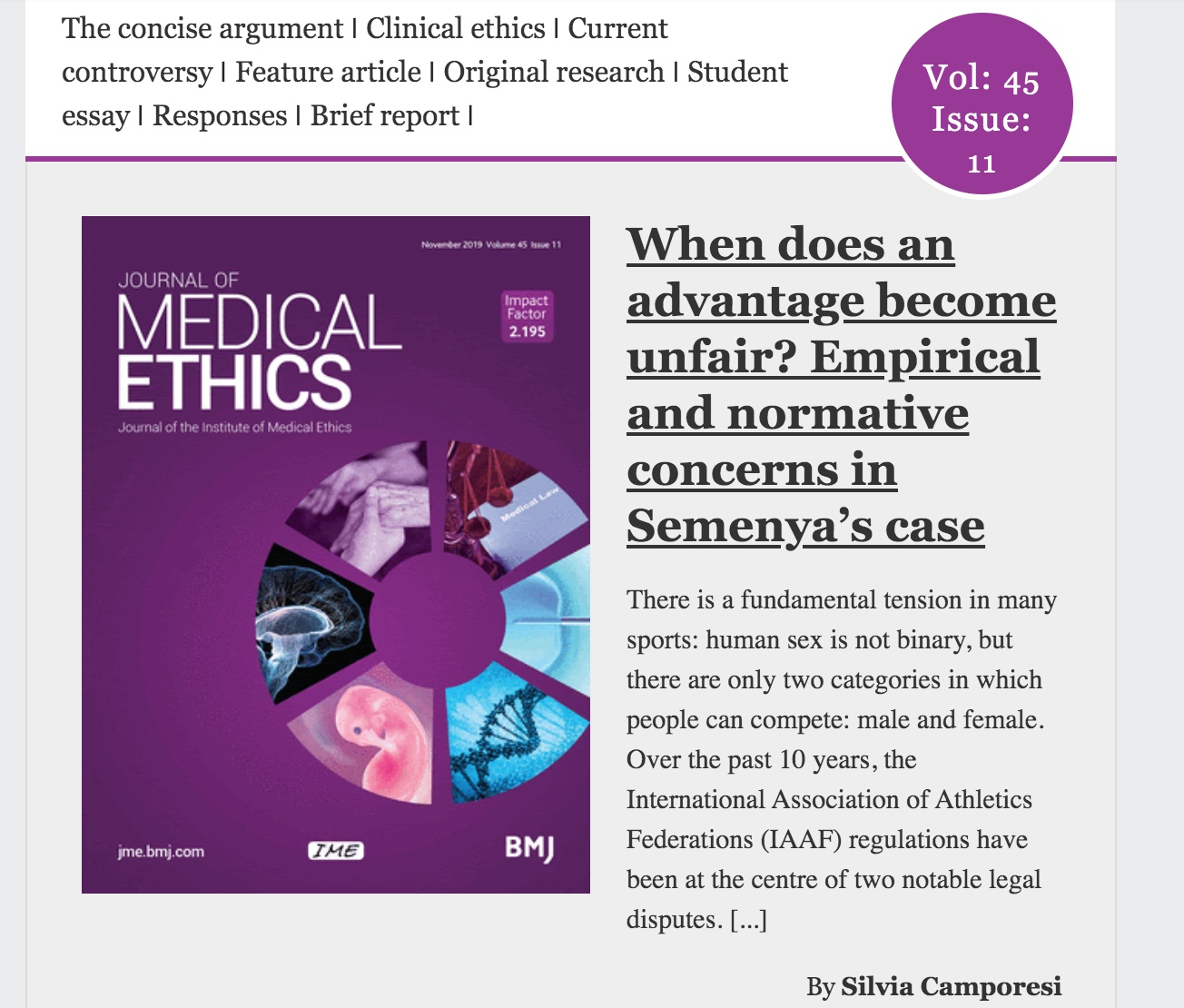 Here’s the abstract:
 Prof. Silvia Camporesi
You must be logged in to post a comment.