Category Archives: Philosophy of Sport

New paper out with Matija Mato Škerbić on Techno-optimism and the Enhanced Games

New paper out with Matija Mato Škerbić in the Journal of the Philosophy of Sport: Techno-optimism and the Enhanced Games: a critical analysis of medically supervised radical human enhancement,, DOI: 10.1080/00948705.2026.2691774

Key message of this paper:

Our goal in this paper is not to take a position in favour or against the Enhanced Games (EG), but to unveil their strategy of ‘value alignment’ with philosophy and ethics of sport literature by critically analysing the four pillars that represent the conceptual foundation of the EG. 

The EG can be interpreted – and, to the best of our knowledge, we are the first to do so – as engaging in a form of value alignment strategy analogous to those identified in AI ethics. Rather than simply rejecting existing norms in sport, the EG actively seek to reframe their practices in relation to core concepts within the philosophy of sport, such as spirit of sport, the pursuit of excellence and the role of technology in enhancing performance. In doing so, they attempt to secure a form of normative legitimacy by presenting enhancement not as a deviation from sporting values, but as a more explicit and consistent realization of them. This strategy mirrors broader patterns in technological governance, where ethical frameworks are used not only to regulate practices, but also to render them socially acceptable.

From this perspective, the EG can be interpreted as an effort to realign the value structure of elite sport itself, shifting the justificatory basis of competition away from natural limits and towards openly enhanced human capability.

If you’d like to read the full paper, DM me for pdf.
New research output out with Bianchini “Assistive Technologies, Brain-Computer Interfaces and the Radical Cyborgization of Athletes”

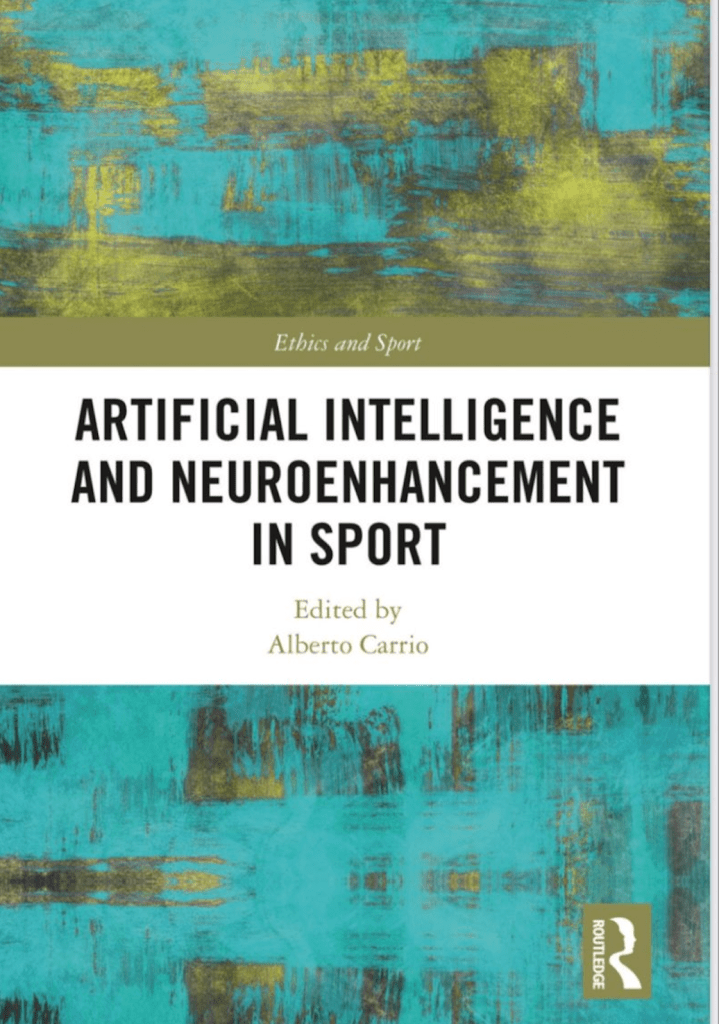
Delighted to see this chapter with Francesco Bianchini, Professor of logic and philosophy of cognitive sciences, University of Bologna, now published for this Routledge volume ‘Artificial Intelligence and Neuroenhancement in sport‘ edited by Alberto Carrio, University Pompeu Fabra, for the series ‘Ethics in Sport’.

Here are a few things we argue in this chapter:

  1. The performance capacities of athletes using assistive technology go generally unchallenged, until their performances begin to approach the current, and necessarily contingent upper human limit, which is determined based on the performance of an athlete without assistive technology.
  2. Sports governing bodies address concerns of unfair advantage from assistive technologies by comparing athletes’ performances to current able-bodied human capabilities. This approach, which we term a ‘strategy of containment’, reflects widespread ableist assumptions in sports. It is a strategy designed to exclude athletes who are perceived as challenging the dominant status of able-bodied competitors.
  3. The integration of AI with assistive technologies could drive an evolution of sports beyond the binary categorisation in able-bodied events and para-events. To this end we first discuss the Cybathlon, which offers the possibility to experiment with radical new functionalities of the body, which go beyond mere restoration to previous functions or augmentation of existing functions. We also discuss brain-computer interfaces (BCI), which may lead to forms of compensation and standardization based on a minimum set of standard characteristics required for a given discipline.
  4. We argue that an inclusive approach to sports which integrates AI with assistive technologies would focus not only on the idea of ‘leveling the playing field’ using the able-bodied human norm as a standard, but rather on comparing athletic aspects and performance elements of AI-integrated assisted technologies using the ‘cyborg’ as the new benchmark for human performance. Ultimately, this could enable able-bodied athletes and those requiring assistive technologies to compete together in a new category of human athletes for whom technology can be read at multiple levels as assistive, optimising, or enhancing.

Browse other great chapters included in this edited volume here!

https://www.routledge.com/Artificial-Intelligence-and-Neuroenhancement-in-Sport/Carrio/p/book/9781032858814

New paper with Ludovica Lorusso “Uses and abuses of the concept of race in the genomics of sport performance and sport-related traumatic brain injury”

New paper out with Ludovica Lorusso in Sports Ethics and Philosophy “Uses and abuses of the concept of race in genomics of sport performance and sport-related traumatic brain injury”:

https://www.tandfonline.com/doi/abs/10.1080/17511321.2024.2361916

Ludovica Lorusso is a philosopher of science who has written extensively about race in the past. Ludovica and I decided to work together to and combine Ludovica’s philosophy of science expertise and my ethics of sport expertise to tackle the issue of the race in sport genomics and concussion research.

There’s not much written about race in the philosophy and ethics of sport literature, and that’s a problem for a variety of reasons.
We encourage you to read our paper and welcome your comments and criticisms to take our research forward!

We would also like to express our gratitude to the participants of the joint conference European Association for Philosophy of Sport and British Philosophy of Sport Association which took place at KU Leuven in April 2023, and to the participants of the 2023/24 seminar series of the Research Center for Knowledge in Cognition of the University of Bologna for their invaluable feedback.

hashtag#race hashtag#reification hashtag#stereotypethreat hashtag#traumaticbraininjury hashtag#concussion hashtag#philofsport hashtag#criticalstudiesrace