“Why we should eliminate the distinction between the Olympics and the Paralumpics”, or better: why athletes who competed with assistive technologies, such as the Paralympic long-jumper Markus Rehm, or the American 400 meter runner Blake Leeper, should be allowed to compete in the Olympics.
World Athletics current requires athletes who compete with assistive technologies to demonstrate that their assistive technology does not provide them with an unfair advantage over able-bodied athletes.
But, is this rule, fair?
There is no such upper limit on able-bodied athletes to demonstrate that they do not have an unfair advantage over other able-bodied athletes.
In my TEDx speech I argue that this rule is unfair and discriminatory, and that athletes with assistive technologies should be allowed to compete with “able-bodied” athletes when they meet the qualifying times or qualifying measures for the events.
I would cherish the opportunity to do a TEDx talk in English on this topic!
Contact me at silvia.camporesiATgmail.com to discuss TEDx opportunities.
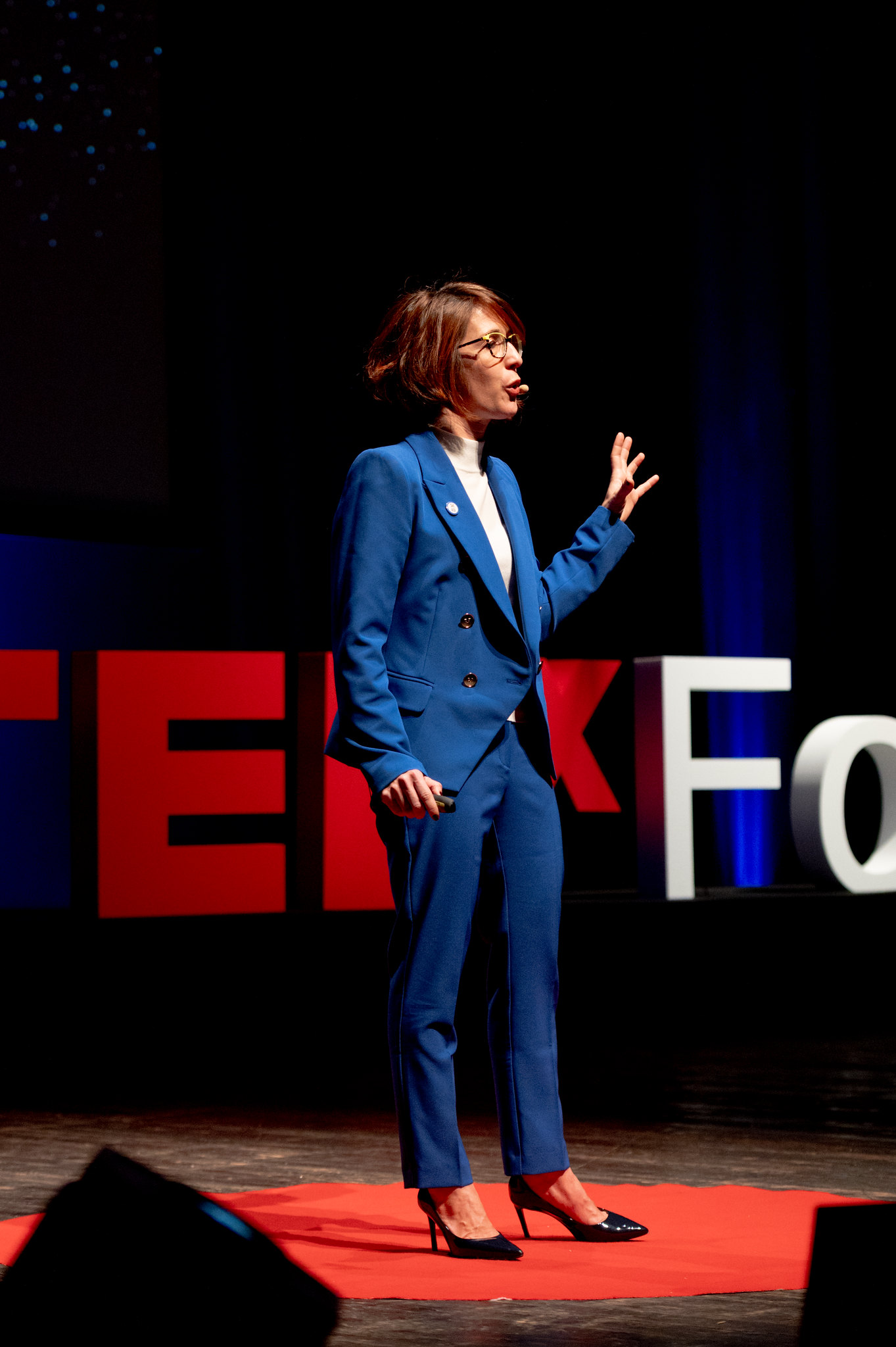
On February 3rd, 2024, I gave my first TEDx Talk in Forlì, Italy. The theme of the TEDxForlì event (held on February 3rd, 2024 in Forlì, Italy) was “Wishes” (“Desideri”, in Italian) and I talked about “Why the Paralympics/Olympics distinction shouldn’t exist anymore”, or better: why athletes who competed with assistive technologies, such as the Paralympic long-jumper Markus Rehm @the.bladejumper, or the American 400 meter runner Blake Leeper @leepster , should be allowed to compete in the Olympics.
World Athletics current requires athletes who compete with assistive technologies to demonstrate that their assistive technology does not provide them with an unfair advantage over able-bodied athletes.
But, is this rule, fair?
There is no such upper limit on able-bodied athletes to demonstrate that they do not have an unfair advantage over other able-bodied athletes. This upper limits disproportionality restricts athletes with assistive technologies on the basis of the “normal human performance” comparator which is based in the able-bodied athlete. Passé!
Some of you will remember the participation of Oscar Pistorius in the London Olympics in 2012. At that time, Pistorius was allowed to compete on the basis of the 2008 historical award (CAS 2008/A/1480 Pistorius v/ IAAF) of the Court for Arbitration of Sport based in Lausanne, Switzerland.
Why haven’t we seen athletes with assistive technologies compete in the Olympics since then?
Because World Athletics changed its rules though and from 2016 onwards implemented the so-called “Markus Rehm’s rule”, which shifts the burden of proof (of demonstrating absence of advantage) from federation to athlete, and which effectively prohibited any athlete with assistive technology from competing with able-bodied athletes when they start running “too fast”. When they are start being perceiving as a “threat”.
In my TEDx speech I argued that this rule is unfair and discriminatory, and that athletes with assistive technologies should be allowed to compete with “able-bodied” athletes when they meet the qualifying times or qualifying measures for the events.
In the future, there will be no humans as we know them: made only of “flesh”. The future of our species is the cyborg body, the synthetic body, the hybrid body. We should embrace these futures. We shouldn’t fear them. They are the only futures we have.
The recording of the TEDx talk is now available here:
This TEDx was in Italian, as such an opportunity arose, however I am very much looking forward to the opportunity to do a TEDx talk or a TED talk in English about assistive technology, disability and inclusion in sport. For inquiries, contact me at silvia.camporesiATgmail.com
While screening and choosing for a ‘disability’ remained a theoretical possibility only a decade ago, it has now become reality. In 2006, Susannah Baruch and colleagues at John Hopkins University published a survey of 190 American preimplantation genetic diagnosis (PGD) clinics, and found that 3% reported having the intentional use of PGD “to select an embryo for the presence of a disability” (deafness or dwarfism).
Photo by William Duke for the NYTImes
In this paper I analyse the real case of genetically deaf parents seeking in vitro fertilization and PGD in the US to choose ‘children like themselves’, i.e. to choose to implant an embryo carrying the mutation for genetic based deafness.
The debate on using PGD to choose what kind of children to bring into the world has been monopolized by the discussion of the different notions of ‘disability’ and by the related topic of the treatment/enhancement distinction. Framed this way, different definitions of disability seem to imply different normative judgments about parental reproductive choices. I here adopt a different perspective, as I shift the debate from the level of ‘disability’ to that of ‘impairment’, and argue that choosing deafness withPGD is morally wrong, without claiming that deafness is a disability. I frame the issue in terms of justice toward the future children and limitation of a reasonably broad array of different life plans. I also support my view in terms of the balance between self-determination of parents within their sphere of reproductive freedom and their determination of future children.


 Prof. Silvia Camporesi
You must be logged in to post a comment.