
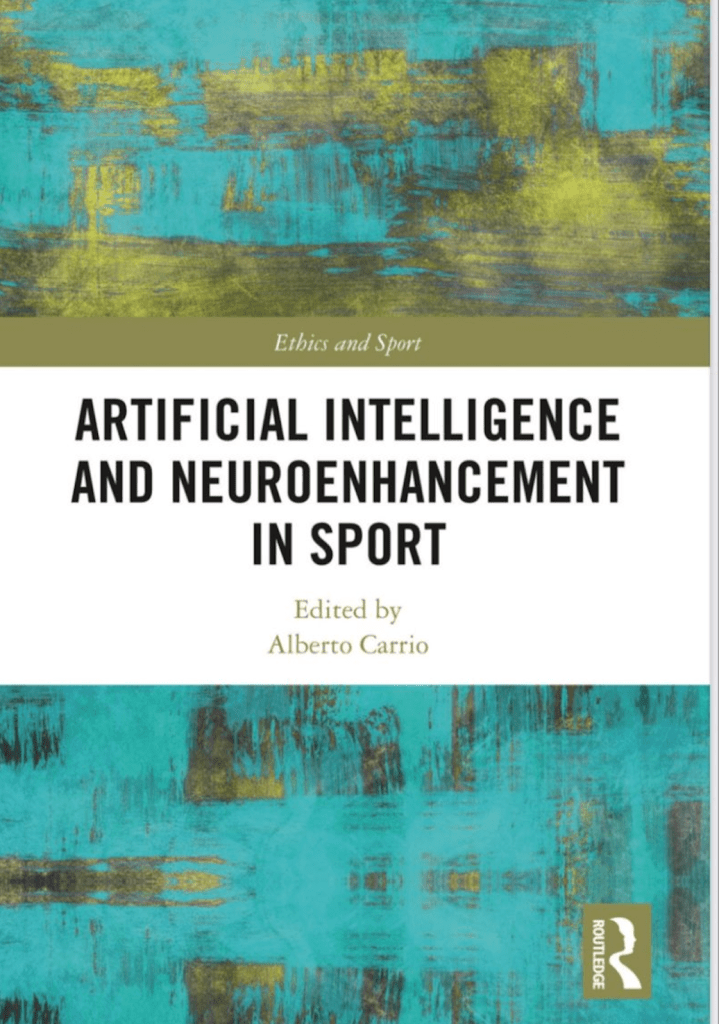
Delighted to see this chapter with Francesco Bianchini, Professor of logic and philosophy of cognitive sciences, University of Bologna, now published for this Routledge volume ‘Artificial Intelligence and Neuroenhancement in sport‘ edited by Alberto Carrio, University Pompeu Fabra, for the series ‘Ethics in Sport’.
Here are a few things we argue in this chapter:
- The performance capacities of athletes using assistive technology go generally unchallenged, until their performances begin to approach the current, and necessarily contingent upper human limit, which is determined based on the performance of an athlete without assistive technology.
- Sports governing bodies address concerns of unfair advantage from assistive technologies by comparing athletes’ performances to current able-bodied human capabilities. This approach, which we term a ‘strategy of containment’, reflects widespread ableist assumptions in sports. It is a strategy designed to exclude athletes who are perceived as challenging the dominant status of able-bodied competitors.
- The integration of AI with assistive technologies could drive an evolution of sports beyond the binary categorisation in able-bodied events and para-events. To this end we first discuss the Cybathlon, which offers the possibility to experiment with radical new functionalities of the body, which go beyond mere restoration to previous functions or augmentation of existing functions. We also discuss brain-computer interfaces (BCI), which may lead to forms of compensation and standardization based on a minimum set of standard characteristics required for a given discipline.
- We argue that an inclusive approach to sports which integrates AI with assistive technologies would focus not only on the idea of ‘leveling the playing field’ using the able-bodied human norm as a standard, but rather on comparing athletic aspects and performance elements of AI-integrated assisted technologies using the ‘cyborg’ as the new benchmark for human performance. Ultimately, this could enable able-bodied athletes and those requiring assistive technologies to compete together in a new category of human athletes for whom technology can be read at multiple levels as assistive, optimising, or enhancing.
Browse other great chapters included in this edited volume here!
 Prof. Silvia Camporesi
You must be logged in to post a comment.